What Is a Word That Means Will Never Be Happy Again

Saudade (,[1] European Portuguese: [sɐwˈðaðɨ], Brazilian Portuguese: [sawˈdad(ʒ)i], Galician: [sawˈðaðɪ]; plural saudades)[two] is a deep emotional state of nostalgic or profound melancholic longing for something or someone that one cares for and/or loves. Moreover, information technology often carries a repressed noesis that the object of longing might never be had again. It is the recollection of feelings, experiences, places, or events that one time brought excitement, pleasure, and well-existence, which now trigger the senses and brand ane experience the hurting of separation from those joyous sensations. Saudade describes a feeling both happy and sad, and could be approximated by the English expression 'bitter sweetness'.
Nascimento and Meandro (2005)[3] cite Duarte Nunes Leão's definition of saudade: "Memory of something with a desire for information technology."
In Brazil, the day of Saudade is officially historic on 30 January.[4] [5]
History [edit]

The distant lands of the Portuguese Empire made a special longing for the loved ones of explorers and sailors
Saudade ultimately derives from the Latin solitās, solitātem, meaning "confinement". The word saudade was used in the Cancioneiro da Ajuda (13th century), in the Cancioneiro da Vaticana and by poets of the fourth dimension of Male monarch Denis of Portugal[6] (reigned 1279–1325). Some specialists argue that the word may have originated during the Great Portuguese Discoveries, expressing and giving meaning to the sadness felt about those who departed on journeys to unknown seas and oft disappeared in shipwrecks, died in battle, or simply never returned. Those who stayed backside—more often than not women and children—suffered deeply in their absenteeism. Yet, the Portuguese discoveries only started in 1415, and since the word has been constitute in earlier texts, this does not constitute a very expert caption. The Reconquista also offers a plausible caption.[ citation needed ]
The state of mind has afterward become a "Portuguese way of life": a abiding feeling of absenteeism, the sadness of something that'southward missing, wistful longing for completeness or wholeness and the yearning for the render of what is now gone, a want for presence as opposed to absence—equally it is said in Portuguese, a strong desire to matar every bit saudades (lit. to kill the saudades).
In the latter half of the 20th century, saudade became associated with the longing for one's homeland, as hundreds of thousands of Portuguese-speaking people left in search of better futures in S America, N America, and Western Europe. Besides the implications derived from a moving ridge of emigration trend from the motherland, historically speaking saudade is the term associated with the reject of Portugal's office in world politics and trade. During the and so-called "Golden Age", synonymous with the era of discovery, Portugal rose to the status of a world power, and its monarchy became one of the richest in Europe. But with the competition from other European nations, the land went both colonially and economically into a prolonged period of decay. This period of decline and resignation from the earth'due south cultural phase marked the ascension of saudade, aptly described by a judgement in Portugal's national anthem: Levantai hoje de novo o esplendor de Portugal (Lift up once again today the splendour of Portugal).
Definition [edit]
The Dicionário Houaiss da Língua Portuguesa defines saudade (or saudades) as "A somewhat melancholic feeling of incompleteness. It is related to thinking dorsum on situations of privation due to the absence of someone or something, to motion away from a identify or thing, or to the absenteeism of a ready of item and desirable experiences and pleasures once lived."[7]
The Dictionary from the Royal Galician Academy, on the other hand, defines saudade as an "intimate feeling and mood caused by the longing for something absent-minded that is being missed. This tin take dissimilar aspects, from concrete realities (a loved i, a friend, the motherland, the homeland...) to the mysterious and transcendent. It is quite prevalent and characteristic of the Galician-Portuguese world, but it can also be found in other cultures."
[edit]
Saudade is a word in Portuguese and Galician that claims no direct translation in English language. However, a close translation in English would exist "desiderium." Desiderium is defined as an agog desire or longing, peculiarly a feeling of loss or grief for something lost. Desiderium comes from the word desiderare, meaning to long for. Connections between desiderium and nostalgia have also been fatigued; the former can be seen as expressing the latter for things that tin can't be experienced any more, or things that someone may have never experienced themselves.[8]
In Portuguese, "Tenho saudades tuas" (European Portuguese) or "Estou com saudades de você" (Brazilian Portuguese), translates as "I take (feel) saudade of you lot" pregnant "I miss yous", but carries a much stronger tone. In fact, one can have saudade of someone whom 1 is with, but have some feeling of loss towards the past or the future. For example, one can have "saudade" towards part of the relationship or emotions one time experienced for/with someone, though the person in question is however office of one's life, equally in "Tenho saudade do que fomos" (I feel "saudade" of the way we were). Another example tin illustrate this utilise of the discussion saudade: "Que saudade!" indicating a general feeling of longing, whereby the object of longing tin can be a full general and undefined entity/occasion/person/group/period etc. This feeling of longing can be accompanied or better described by an abstruse will to be where the object of longing is.
Despite beingness hard to translate in full, saudade has equivalent words in other cultures, and is often related to music styles expressing this feeling such as the dejection for African-Americans, Sehnsucht in German, dor in Romania, Tizita in Ethiopia, Hiraeth in Welsh, or Assouf for the Tuareg people, appocundria in Neapolitan. In Slovak, the word is clivota or cnenie, and in Czech, the word is stesk. In Turkish, the word Hasret significant longing, yearning or nostalgia has similar connotations.
The similar melancholic music style is known in Bosnia-Herzegovina every bit sevdah (from Turkish sevda: infatuation, ultimately from Arabic سَوْدَاء sawdā' : 'blackness [bile]', translation of the Greek µέλαινα χολή, mélaina cholē from which the term melancholy is derived).
Elements [edit]

Saudade is similar but non equal to nostalgia, a word that also exists in Portuguese.
In the volume In Portugal of 1912, A. F. One thousand. Bell writes:
The famous saudade of the Portuguese is a vague and constant desire for something that does non and probably cannot exist, for something other than the present, a turning towards the past or towards the future; non an active discontent or poignant sadness but an indolent dreaming wistfulness.[nine]
A stronger class of saudade may exist felt towards people and things whose whereabouts are unknown, such as old means and sayings; a lost lover who is sadly missed; a faraway identify where i was raised; loved ones who accept died; feelings and stimuli one used to have; and the faded, nevertheless gilt memories of youth. Although information technology relates to feelings of melancholy and fond memories of things/people/days gone by, information technology tin can be a rush of sadness coupled with a paradoxical joy derived from acceptance of fate and the promise of recovering or substituting what is lost by something that volition either fill in the void or provide consolation.
To F. D. Santos, Saudade as a noun has become a longing for longing itself:
At that place was an evolution from saudades (plural) to Saudade (atypical, preferably written with a capital Due south), which became a philosophical concept. ... Saudade has an object; however, its object has get itself, for it means 'nostalgia for nostalgia', a meta-nostalgia, a longing oriented toward the longing itself. Information technology is no more than the Loved Ane or the 'Return' that is desired, based on a sense of loss and absence. Now, Desire desires Want itself, equally in the poetry of love for love's sake in Arabic, or as in Lope de Vega's famous epigram virtually the Portuguese who was crying for his love for Love itself. Or, rather, as poetess Florbela Espanca put it, I long for the longings I don't have ('Anoitecer', Espanca 1923).[10]
Music [edit]
As with all emotions, saudade has been an inspiration for many songs and compositions. "Sodade" (saudade in Cape Verdean Creole) is the title of the Republic of cape verde singer Cesária Évora'south most famous song. Étienne Daho, a French vocalist, too produced a song of the same proper noun. The Expert Son, a 1990 album past Nick Cave and the Bad Seeds, was heavily informed by Cave's mental state at the time, which he has described as saudade. He told journalist Chris Bohn: "When I explained to someone that what I wanted to write nearly was the memory of things that I thought were lost for me, I was told that the Portuguese word for this feeling was saudade. Information technology's not nostalgia simply something sadder."
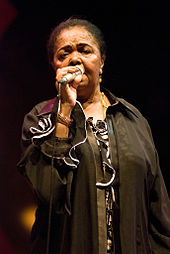
Cape Verdean pop vocalizer Cesária Évora had her biggest hit singing about saudade
The usage of saudade equally a theme in Portuguese music goes dorsum to the 16th century, the golden age of Portugal. Saudade, also as love suffering, is a common theme in many villancicos and cantigas composed by Portuguese authors; for example: "Lágrimas de Saudade" (tears of saudade), which is an anonymous work from the Cancioneiro de Paris. Fado is a Portuguese music style, by and large sung by a single person (the fadista) along with a Portuguese guitar. The most popular themes of fado are saudade, nostalgia, jealousy, and curt stories of the typical city quarters. Fado and saudade are intertwined key ideas in Portuguese civilisation. The word fado comes from Latin fatum pregnant "fate" or "destiny". Fado is a musical cultural expression and recognition of this unassailable determinism which compels the resigned yearning of saudade, a bitter-sweet, existential yearning and hopefulness towards something over which one has no control.
Spanish vocalist Julio Iglesias, whose father is a Galician, speaks of saudade in his song "Un Canto a Galicia" (which roughly translates as "a song/dirge for Galicia"). In the vocal, he passionately uses the phrase to draw a deep and pitiful longing for his motherland, Galicia. He also performs a vocal chosen "Morriñas", which describes the Galicians as having a deeply stiff saudade.
The Paraguayan guitarist Agustin Barrios wrote several pieces invoking the feeling of saudade, including Choro de Saudade and Preludio Saudade. The term is prominent in Brazilian popular music, including the first bossa nova song, "Chega de Saudade" ("No more saudade", usually translated as "No More Blues"), written past Tom Jobim. Jazz pianist Neb Evans recorded the melody "Saudade de Brasil" numerous times. In 1919, on returning from two years in Brazil, the French composer Darius Milhaud composed a suite, Saudades do Brasil, which exemplified the concept of saudade. "Saudade (Part Two)" is besides the title of a flute solo past the band Shpongle. The fado vocalizer Amália Rodrigues typified themes of saudade in some of her songs. J-Rock band Porno Graffitti has a song entitled "サウダージ", "Saudaaji" transliterated ("Saudade"). The alternative stone band Dearest And Rockets has a song named "Saudade" on their anthology Seventh Dream of Teenage Heaven. June 2012 brought Bearcat's release of their self-titled indie album that included a song called "Saudade".
The Dutch jazz/Stone guitarist Jan Akkerman recorded a composition called "Saudade", the centerpiece of his 1996 anthology Focus in Fourth dimension. The Belgian electronic music band Arsenal recorded a song called "Saudade" on their album Outsides (2005). The jazz fusion group Trio Across, consisting of John Scofield, Jack DeJohnette, and Larry Goldings released in 2006 an album dedicated to drummer Tony Williams (1945–1997), called Saudades. Dance music artist Peter Corvaia released a progressive house track entitled "Saudade" on HeadRush Music, a sub-characterization of Toes in the Sand Recordings. New York Metropolis mail-rock band Mice Parade released an album entitled Obrigado Saudade in 2004. Chris Rea as well recorded a song entitled "Saudade Part 1 & 2 (Tribute To Ayrton Senna)" as a tribute to Ayrton Senna, the Brazilian three-times Formula One globe champion killed on the track in May 1994. There is an ambient/dissonance/shoegazing band from Portland, Oregon, named Saudade. The rock band Extreme has a Portuguese guitarist Nuno Bettencourt; the influence of his heritage tin can be seen in the band'southward anthology Saudades de Rock. During recording, the mission statement was to bring back musicality to the medium. "Nancy Espana", a song past Barney Blitz, made famous past an adaptation by Christy Moore, is another example of the use of saudade in contemporary Irish gaelic music, the chorus of which is:
"No matter where I wander I'm withal haunted by your name
The portrait of your beauty stays the aforementioned
Continuing by the ocean wondering where you've gone
If you'll return again
Where is the band I gave to Nancy Kingdom of spain?"
American vocalist/songwriter Grayson Hugh wrote a vocal called "Saudade" that he performed with jazz guitarist Norman Johnson on Johnson'south 2013 anthology "Get It While Yous Tin".
Kingston-Upon-Hull IDM Electronica, Downtempo and Deep Groove legend, Steve Cobby, of Fila Brazillia, Solid Doctor, Heights of Abraham, the Twilight Singers debut notoriety and other musical incarnations and collaborations, released a 12 track album "Saudade"[11] in March 2014 on DÉCLASSÉ Recordings.
Washington DC electronica duo Thievery Corporation released the studio album Saudade in 2014 via their Eighteenth Street Lounge Music label.
Brazilian singer Ana Frango Electrico released a song called "Saudade" as the opening track on their 2019 album "Footling Electric Chicken Heart"
A. R. Rahman's soundtrack for the 2020 Hindi pic Dil Bechara features an instrumental track called "The Horizon of Saudade".
In 2022, Portuguese vocaliser Maro released a song called "Saudade, saudade" and will correspond Portugal with it in the Eurovision Song Competition 2022 in Turin, Italy.[12]
Literature [edit]
The Portuguese author Fernando Pessoa'southward posthumous drove of writings The Volume of Ailment is written almost entirely in a tone of saudade, and deals with themes of nostalgia and breach.[ citation needed ] Australian writer Suneeta Peres Da Costa'south novella Saudade follows Maria, a young daughter from a Goan immigrant family, growing up in a political hierarchy of racism and colonialism[13]
Variations [edit]
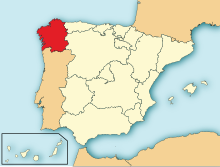
The Castilian region of Galicia (cherry) lies north of Portugal and shares a cultural history of saudade.
Saudade is also associated with Galicia, where information technology is used similarly to the word morriña (longingness). Yet, morriña often implies a deeper phase of saudade, a "saudade so stiff it can even impale," as the Galician saying goes. Morriña was a term often used by emigrant Galicians when talking well-nigh the Galician motherland they left behind. Although saudade is also a Galician word, the meaning of longing for something that might return is generally associated with morriña. A literary example showing the understanding of the difference and the use of both words is the song Un canto a Galicia past Julio Iglesias. The give-and-take used by Galicians speaking Castilian has spread and get mutual in all Kingdom of spain and fifty-fifty accepted past the Academia.[fourteen]
In Portugal, morrinha is a word to describe sprinkles, while morrinhar means "to sprinkle." (The virtually mutual Portuguese equivalents are chuvisco and chuviscar, respectively.) Morrinha is besides used in northern Portugal for referring to sick animals, for example of sheep dropsy,[14] and occasionally to sick or sad people, often with irony. It is also used in some Brazilian regional dialects for the smell of moisture or sick animals.
In Goa, India, which was a Portuguese colony until 1961, some Portuguese influences still remain. A suburb of Margão, Goa's largest metropolis, has a street named Rua de Saudades. It was aptly named because that very street has the Christian cemetery, the Hindu shmashana (cremation basis) and the Muslim qabrastan (cemetery). Virtually people living in the city of Margão who pass by this street would agree that the name of the street could not be whatever other, as they often recall fond memories of a friend, loved one, or relative whose remains went by that road. The discussion saudade takes on a slightly dissimilar form in Portuguese-speaking Goan families for whom information technology implies the in one case-cherished just never-to-return days of celebrity of Goa every bit a prized possession of Portugal, a notion since then made redundant by the irrevocable cultural changes that occurred with the stop of the Portuguese regime in these parts.
In Greatcoat Verdean Creole there is the word sodadi (besides spelled sodade), originated in the Portuguese saudade and exactly with the same pregnant.
Encounter also [edit]
- Grief
- Han
- Hiraeth
- Mono no enlightened
- Nostalgia
- Sehnsucht
- Good erstwhile days
References [edit]
- ^ "Saudade". Lexico Uk English Dictionary. Oxford University Press. n.d.
- ^ Priberam Informática, S.A. "Significado / definição de saudade no Dicionário Priberam da Língua Portuguesa". Archived from the original on 8 November 2009. Retrieved 14 January 2010.
- ^ "MEMORANDUM 08 - NASCIMENTO A.R.A e MENANDRO P.R.G." world wide web.fafich.ufmg.br. Archived from the original on 22 April 2018. Retrieved 30 January 2016.
- ^ "Portoweb - Datas Comemorativas". Archived from the original on 24 July 2011. Retrieved thirty January 2010.
- ^ "Dia da Saudade. Origem e curiosidades sobre o Dia da Saudade - Brasil Escola". Brasil Escola. Archived from the original on 13 February 2010. Retrieved 30 Jan 2010.
- ^ Basto, Cláudio. "Saudade em português due east galego". Revista Lusitana, Vol XVII, Livraria Clássica Editora, Lisboa 1914.
- ^ Dicionário Houaiss da língua portuguese (Brazilian Portuguese Dictionary).
- ^ "Desiderium, and More Obscure Feeling Words". www.merriam-webster.com . Retrieved eleven January 2020.
- ^ Bell, A. F. (1912) In Portugal. London and New York: The Bodley Head. Quoted in Emmons, Shirlee and Wilbur Watkins Lewis (2006) Researching the Song: A Lexicon. Oxford and New York: Oxford University Printing, p. 402.
- ^ Santos, Filipe D. (2017). Didactics and the Boarding School Novel, The Work of José Régio. Rotterdam: Sense Publishers. p. 102. ISBN978-94-6300-739-9. Archived from the original on four September 2017. Retrieved 3 September 2017.
- ^ "Saudade, by Steve Cobby". Déclassé Recordings. Archived from the original on fifteen April 2017. Retrieved xv April 2017.
- ^ Land, Teddy. "MARO will represent Portugal at Eurovision 2022 with 'saudade, saudade'". aussievision.cyberspace.
- ^ Saudade, Peres Da Costa, Giramondo Publishing, March 2018 https://giramondopublishing.com/product/saudade/ Archived 18 March 2018 at the Wayback Auto
- ^ a b morriña Archived 13 Feb 2013 at archive.today in the Spanish-language Diccionario de la Real Academia.
Farther reading [edit]
- Lourcenço, Eduardo (1999). Mitologia da saudade (Seguido de Portugal como destino) (in Portuguese). São Paulo: Companhia das Letras. ISBN 85-7164-922-seven.
- Rappa, Antonio L. Saudade: The Culture and Security of Eurasians in Southeast Asia. Ethos Books and Singapore Management University's Wee Kim Wee Centre, 2013.
- Ribeiro, Bernardim (Torrao, ~1482 – Lisboa, ~1552). Livro das Saudades (in Portuguese).
External links [edit]
- Emotion every bit Collective Identity: the case of Portuguese Saudade, Marcia Esteves Agostinho, Academia Letters, February 2021
- Aesthetics of Saudade – Essay comprising the major theories and explaining the doubts surrounding the translation of saudade
- "BBC Brasil": Saudade is the 7th nigh difficult give-and-take to translate (in Portuguese), London: BBC, 23 June 2004.
- saudade, lexicon.com
Source: https://en.wikipedia.org/wiki/Saudade
0 Response to "What Is a Word That Means Will Never Be Happy Again"
Post a Comment